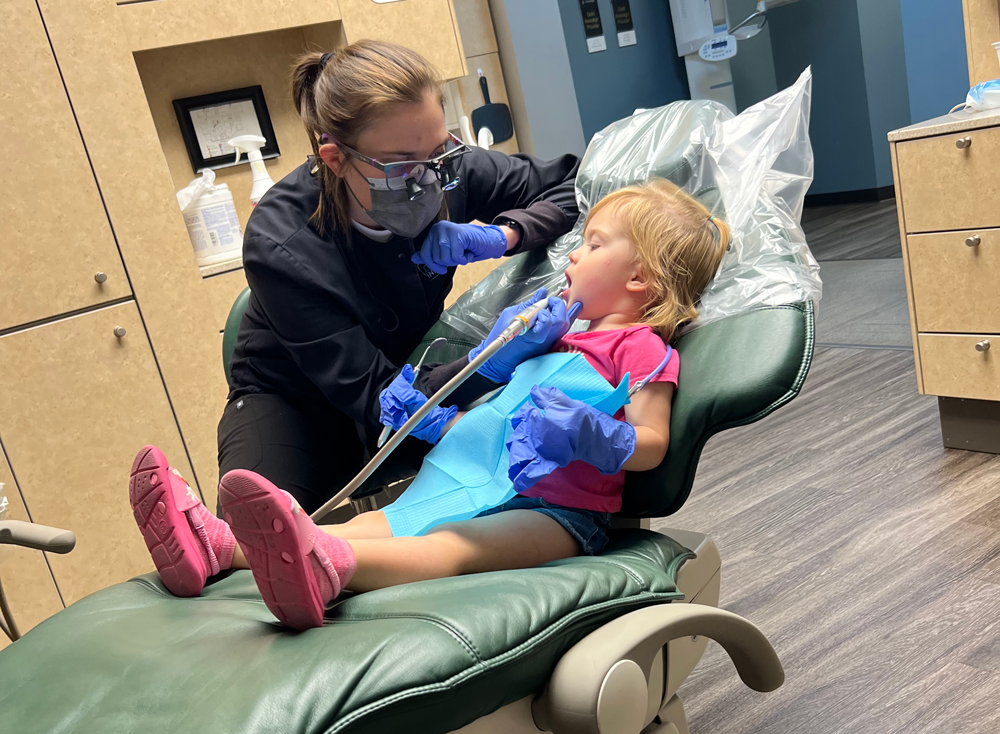
The American Dental Association recommends that all children should first see the dentist sometime after their first tooth appears, but no later than their first birthday. This allows the dentist to evaluate the child for signs of proper growth and development, as well as to make sure that their baby teeth are in good condition. Of course, we hope that all children develop with no problems, however, the earlier an issue where growth and development are concerned can be identified, the better. Baby teeth are very important, because they act as placeholders for the adult teeth and help maintain the proper amount of space needed for our adult teeth to erupt into place. They also help with the development of proper speech, and of course, chewing!
We also want the opportunity to look beyond just the child’s teeth. Lots of research has been conducted in the world of dentistry concerning airway issues in children and how that can impact their growth and development. While a dentist may not necessarily be the doctor that treats these possible issues, we can often identify them and discuss treatment options with parents. If you have any concerns related to your child’s behavior, sleeping, or eating, please let your dentist know! Sometimes restricted movement of the tongue, often referred to as a “tongue tie,” can result in difficulties with feeding and speech; these tongue ties in infants can also cause difficulty with breastfeeding. Similarly, a restricted airway can lead to difficulty sleeping and even behavioral problems. If your child has any of these issues, it is worth mentioning them to your dentist.
Statistics show 40 million children can be affected by sleep disorders and 9 out of 10 children are suffering from one or more symptoms of sleep related breathing symptoms. Healthy Start evaluates and treats the underlying root cause. Not a band-aid but if started early enough a permanent fix. To find out more information check out www.thehealthystart.com
Brushing and flossing are the best ways to help prevent cavities, but it’s not always easy to clean every nook and cranny of your teeth, when you’re developing proper brushing and flossing techniques – especially those back teeth you use to chew (called molars).
A sealant is a thin, protective coating (made from plastic or other dental materials) that adheres to the chewing surface of back teeth. Sealants have been shown to reduce the risk of decay by nearly 80% in molars. This is especially important when it comes to your child’s dental health.
Dental Innovations of Columbus is a participant in the Amazon Services LLC Associates Program, an affiliate advertising program designed to provide a way for websites to earn advertising revenues by advertising and linking to Amazon.com.